
For global buyers, choosing a China-based Axial Flow Fan manufacturer means looking beyond price and catalog airflow. The right supplier should explain how its fan performs under your actual operating conditions. Ask for pressure and airflow data, motor details, noise information, materials, and test methods. A drawing matters, too. Check that the mounting dimensions, blade configuration, and electrical specifications match your installation.
Fan-engineering author Robert Jorgensen is known for his work in the field. A practical paraphrase of the system-selection principle reflected in his work is: “Choose the fan for the system duty, not for a headline airflow figure.” Treat that as guidance, not a verified verbatim quotation. A fan that looks suitable on paper may perform differently once ducts, grilles, or filters add resistance. Small details count.
Supplier checks deserve equal care. Request recent test reports, production quality procedures, sample inspection options, and clear warranty terms. Confirm how the manufacturer handles customization and replacement parts. Compare documentation, not just promises. A neat catalog is not proof. And a low quotation can hide important differences in materials or testing. This guide introduces manufacturers for global buyers, while encouraging practical questions and careful comparison. No single ranking fits every project; the best choice depends on duty point, environment, delivery needs, and the evidence a supplier can provide.
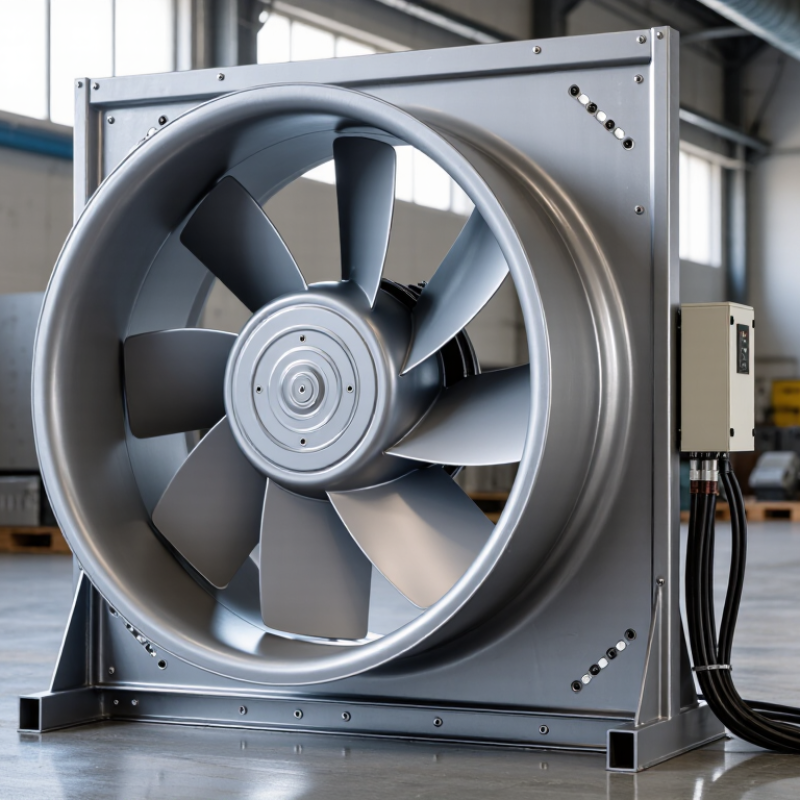
What Axial Flow Fans Are and How They Work
Axial flow fans move air parallel to the shaft. Their blades act like rotating wings. As the impeller spins, air enters from the rear and leaves along the same axis. This design suits ventilation, cooling towers, tunnels, warehouses, and industrial equipment.
Performance depends on blade pitch, diameter, speed, motor efficiency, and system resistance. A larger diameter can move more air at lower rotational speed. However, higher pressure demands may reduce efficiency. The U.S. Department of Energy identifies fan systems as important energy users in commercial and industrial facilities. The International Energy Agency also reports that buildings consume about 30% of global final energy. Better fan selection can therefore reduce operational waste. Testing under ISO 5801 or AMCA methods improves comparison reliability, although field conditions rarely match laboratory results perfectly. That gap deserves attention.
Tips: Check airflow, static pressure, noise, temperature, and duty cycle before purchasing. Measure the duct system, not only the fan. A fan running loudly may be oversized, poorly balanced, or facing unexpected resistance. Select efficient motors and variable-speed control where demand changes. Keep blades clean and inspect bearings regularly. Small maintenance errors matter.
Axial flow fans move air parallel to the rotating shaft. The chart shows the theoretical airflow produced by different fan diameters at a constant face velocity of 8 m/s, calculated using Q = v × π × (D/2)². Actual performance varies with blade design, motor speed, and system resistance.
Key insight: At the same air velocity, airflow increases with the square of fan diameter, so a larger axial fan can move substantially more air without a proportional increase in diameter.
Axial flow fans support air movement where high volume and moderate pressure are required. Their applications span ventilation, cooling, drying, and smoke control. The International Energy Agency’s The Future of Cooling report projects global space-cooling demand could more than triple by 2050. This trend increases demand for efficient fan systems in commercial buildings, factories, warehouses, and transport hubs.
In industrial plants, axial fans remove heat from furnaces, compressors, transformers, and production lines. In agriculture, they improve air exchange inside poultry houses and greenhouses, where stagnant air can damage crops or increase animal stress. Mining sites and road tunnels use high-capacity units to dilute dust and exhaust gases. Data centers are another fast-growing application. According to the IEA’s Electricity 2024 report, data centers used about 460 TWh of electricity worldwide in 2022, with demand potentially exceeding 1,000 TWh by 2026. Fan efficiency now affects both cooling reliability and operating cost.
Selection requires more than checking airflow. Engineers should examine static pressure, noise, corrosion, temperature, control mode, and maintenance access. A fan that performs well in a clean warehouse may struggle in a dusty cement plant. That detail is often underestimated. The U.S. Department of Energy recommends reviewing fan-system design, duct resistance, and variable-speed control to reduce wasted energy. However, variable-speed control is not automatically the best answer; poor commissioning can create unstable airflow. Field measurements, such as anemometer readings and motor-load checks, make the final choice more reliable.
China’s leading axial flow fan manufacturers serve ventilation, cooling, tunnel, agricultural, and industrial applications. Their advantage is practical engineering at scale. Many factories combine CNC blade forming, dynamic balancing, motor testing, and export inspection under one roof. Buyers should request airflow curves, pressure data, sound levels, and efficiency results for the exact operating point.
The International Energy Agency reports that buildings consume about 30% of global final energy. Its Future of Cooling report also warns that cooling demand could triple by 2050. This makes fan efficiency more than a purchasing detail. Chinese manufacturers increasingly offer electronically commutated motors, adjustable-pitch blades, and variable-speed controls. A 1.2-meter impeller may move substantial air, but performance changes sharply with duct resistance and installation angle. Catalogue figures alone can mislead.
Reliable suppliers usually provide testing aligned with standards such as ISO 13350, AMCA 210, or relevant IEC requirements. Ask for vibration limits, ingress protection, insulation class, and material specifications. Galvanized steel suits humid workshops, while aluminum or coated components may better resist corrosion. Factory audits should include balancing records and a witnessed run test. Small details matter.
Some product pages still present impressive airflow without clear static pressure. That weakness deserves attention. A technically strong manufacturer should explain tolerances, duty cycles, replacement parts, and field service before receiving an order. Performance claims should remain traceable to a test report, not only a sales sheet.
The specifications below are indicative product-category ranges, not guaranteed limits for every manufacturer or model. Actual performance depends on fan design, system resistance, air density, installation, and test conditions.
| Product or Evaluation Area | Typical Range or Reference | What Global Buyers Should Check |
|---|---|---|
| Small ventilation and equipment-cooling fans | Approx. 200–500 mm impeller diameter; airflow and pressure vary substantially by blade design and speed. | Confirm operating point, noise level, mounting dimensions, guarding, and whether the quoted airflow is free-air or measured against resistance. |
| General-purpose industrial axial fans | Approx. 400–1,250 mm diameter; many applications use low-to-medium static pressure, often within roughly 50–500 Pa. | Request a certified or documented fan curve showing airflow, pressure, power, and efficiency at the required duty point. |
| Large industrial or tunnel ventilation fans | Large installations may use impeller diameters above 1,250 mm; airflow can reach tens or hundreds of thousands of m³/h depending on the design. | Check system calculations, installation losses, vibration limits, access for maintenance, and the complete assembly dimensions and weight. |
| Tube-axial and vane-axial configurations | Tube-axial fans are commonly housed in a cylindrical casing; vane-axial designs add guide vanes to improve flow straightening and pressure performance. | Select the configuration based on the required pressure, duct layout, available space, and operating point—not airflow alone. |
| Airflow and pressure performance | Airflow is commonly stated in m³/h or m³/s; pressure is commonly stated in Pa. Values must be associated with a defined test method and operating condition. | Compare like-for-like fan curves and clarify whether pressure is static or total pressure, as well as the air density and test arrangement. |
| Motor and electrical supply | Motor voltage, frequency, power, pole count, protection rating, and insulation class depend on the model and destination market. | Specify the local supply, starting method, control requirements, ambient conditions, and required motor protection. Confirm the nameplate data before shipment. |
| Speed control | Control may use a compatible variable-frequency drive or another method appropriate to the motor and fan design. | Confirm motor-drive compatibility, minimum operating speed, cooling at reduced speed, and any resonance or vibration restrictions. |
| Noise and vibration | Sound and vibration depend on operating point, fan construction, installation, and measurement conditions; there is no single representative value for all axial fans. | Request measurement conditions and data at the specified duty point. Check balancing documentation and the applicable project acceptance criteria. |
| Performance testing reference | ISO 5801 provides standardized methods for determining fan performance using standardized airways. | Ask which test method and test configuration were used, and whether the reported results apply to the supplied fan assembly. |
| Fire and smoke-control applications | Fire-rated smoke-extract duties require application-specific qualification; EN 12101-3 is a relevant European standard for powered smoke and heat control ventilators. | Verify the exact certified configuration, temperature-time rating, installation conditions, and local authority requirements. A standard reference alone does not establish product compliance. |
| Materials and environment | Casing and impeller materials vary by duty and may include coated steel, stainless steel, or aluminum alloys. | State corrosion exposure, humidity, temperature, dust or chemical exposure, and any required coating or material documentation. |
| Export and delivery documentation | Documentation and import requirements depend on the destination country and the product configuration. | Agree on drawings, datasheets, inspection records, packing details, country-specific conformity documents, spare parts, and warranty terms before ordering. |
Note: The ranges are broad screening references for product selection, not a substitute for a manufacturer’s model-specific datasheet, performance curve, test report, or project compliance review.
Choosing among China’s top axial flow fan manufacturers requires more than comparing catalog prices. Compare tested performance at your actual duty point: airflow, static pressure, speed, power, noise, and efficiency. ISO 5801 and AMCA 210 provide recognized methods for measuring fan performance. Ask each supplier for complete test curves, not only a maximum-airflow figure. A fan moving 120,000 m³/h may perform poorly when duct resistance increases.
Energy deserves careful attention. The U.S. Department of Energy reports that fan systems can consume 15–20% of electricity in industrial facilities. Therefore, a slightly higher purchase price may reduce operating costs. Request motor efficiency data, variable-speed compatibility, and annual energy estimates.
Check impeller balance, blade material, corrosion protection, bearing life, and operating temperature. Small omissions become expensive later.
Tips: Send the same technical schedule to every manufacturer. Compare guaranteed values line by line. Request a witnessed factory test when the project is critical. Confirm spare-part availability, packaging details, lead time, warranty response, and installation guidance. Supplier experience matters, but documents matter more. I would also inspect reference projects personally when possible; online photographs can hide weak finishing and unsuitable duct connections. One imperfect lesson: the cheapest quotation often looks efficient until commissioning begins. Reliability is not always visible in a spreadsheet.
Export Standards, Quality Checks, and Global Sourcing Considerations
Global buyers should evaluate axial flow fan suppliers against documented standards, not attractive catalog figures. ISO 5801 defines airflow and pressure testing methods for industrial fans. AMCA 210 also provides recognized laboratory procedures. These references make supplier comparisons more meaningful. The International Energy Agency reports that electric motor systems consume about 53% of global electricity. Fan efficiency therefore affects both operating cost and emissions.
A reliable factory should provide performance curves, motor certificates, material specifications, and batch inspection records. Check airflow, static pressure, power input, noise, vibration, insulation resistance, and motor temperature rise. Ask for test conditions, because a fan’s rated airflow can change with air density and system resistance. Impellers should be dynamically balanced. Verify protective guards, ingress protection, cable glands, and corrosion treatment before shipment. Small details matter.
Export readiness includes correct manuals, packaging tests, country-specific plugs, customs documents, and traceable serial numbers. ISO 9001 certification can indicate controlled processes, but it does not prove every batch is perfect. That distinction is often missed. In my view, third-party testing is valuable for large orders, especially when samples perform better than production units. Buyers should also inspect wooden cases, shock protection, spare parts, and after-sales response times. Some sourcing decisions still rely too heavily on price. That is a risk worth revisiting.
They suit buildings, tunnels, workshops, farms, cooling areas, and industrial ventilation. Their performance depends on airflow resistance and installation conditions.
Request airflow, static pressure, speed, power, noise, and efficiency data. Ask for a complete performance curve at your operating point.
Maximum airflow usually assumes little resistance. A fan rated at 120,000 m³/h may perform poorly inside restrictive ducts.
Send every supplier the same technical schedule. Compare guaranteed values line by line, including pressure, noise, power, materials, and efficiency.
Galvanized steel suits many humid workshops. Aluminum or coated parts may provide better corrosion resistance in harsher areas.
Review balancing records, motor tests, vibration limits, insulation class, and protection details. For critical projects, request a witnessed factory test.
Not always. A low purchase price may hide higher electricity use, weak bearings, poor balancing, or difficult replacement work.
Confirm spare parts, packaging, delivery time, warranty response, and installation guidance. Field support can matter more than attractive photographs.
Fan systems may consume a significant share of industrial electricity. Variable-speed control and efficient motors can reduce operating costs over time.
Trusting a sales sheet without tracing claims to test reports. It looks efficient on paper, but commissioning may reveal unsuitable duct connections.
This guide explains what an Axial Flow Fan is, how it moves air parallel to the shaft, and why its structure supports efficient ventilation and cooling. It reviews major applications across industrial plants, commercial buildings, agricultural facilities, power systems, warehouses, and other environments that require reliable air movement. Readers will also learn about the capabilities commonly offered by leading Chinese manufacturers, including product customization, production capacity, technical support, and export experience.
The article further outlines practical methods for comparing suppliers, such as evaluating airflow performance, pressure range, energy efficiency, materials, noise levels, durability, testing procedures, and after-sales service. It also highlights important export and sourcing considerations, including international product requirements, quality inspections, documentation, packaging, delivery coordination, and communication. By following these guidelines, global buyers can make informed purchasing decisions and select a suitable Axial Flow Fan supplier according to their application, budget, and long-term operating needs.

Chiye Fan