
How to Choose a Stainless Steel Fan in 2026?

Time:2026-09-25 Author:Madeline
0%

Choosing a Stainless Steel Fan in 2026 calls for more than comparing price tags or motor ratings. The right choice must match airflow, static pressure, operating temperature, and the conditions around the fan. A unit facing washdown, salt spray, or corrosive fumes needs different protection from one moving clean air in a dry warehouse. Small details matter: blade clearance, weld quality, bearing access, and whether the nameplate lists a tested duty point.

Industry data reinforces why material and system choices deserve attention. The International Stainless Steel Forum reported global stainless-steel melt-shop production of 58.4 million tonnes in 2023. That figure describes the material industry, not fan sales, but it shows the scale of stainless steel’s role in manufacturing. The U.S. Department of Energy’s Improving Fan System Performance guide also stresses evaluating the complete fan system, since poor matching between a fan and its operating conditions can waste energy. Check the actual operating point. Do not buy by diameter alone.

AMCA International’s engineering guidance offers a useful expert rule: “Select the fan as part of the system, not as an isolated component.” In this guide, we apply that principle to stainless grades, corrosion exposure, efficiency, noise, and maintenance access. A polished housing may look reassuring. It is not proof of suitability. Ask for material specifications and performance data, then compare them with the real site conditions. The details can be easy to miss. That deserves a second look.
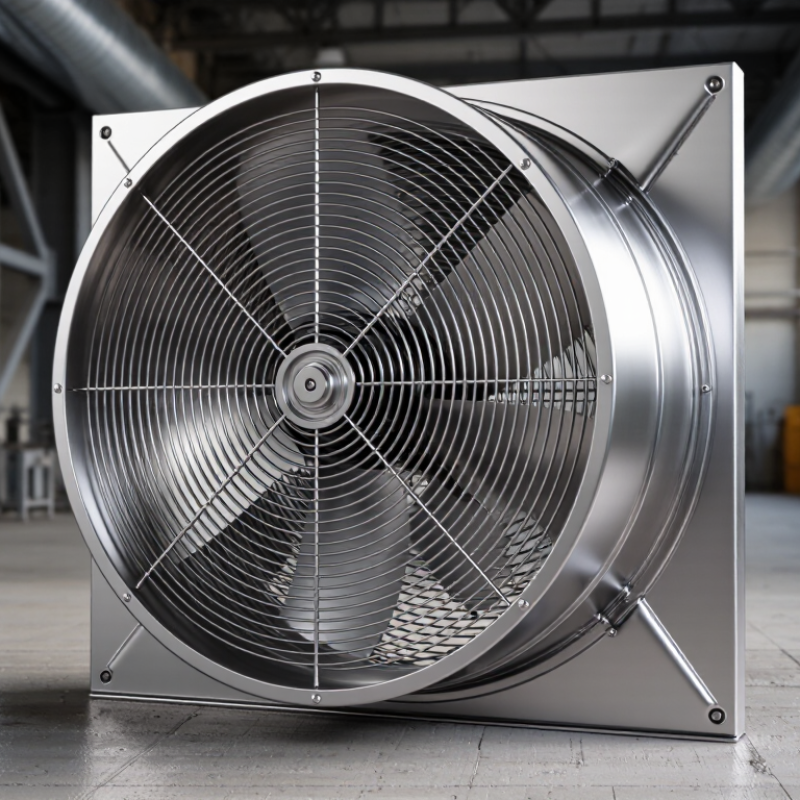
How to Choose a Stainless Steel Fan in 2026?

Define the Operating Environment and Ventilation Requirements

Choosing a stainless steel fan starts with the operating environment, not the finish. Record temperature, humidity, dust, salt, chemicals, washdown frequency, and available space. A polished housing may look suitable, yet hidden corrosion can begin around seams, fasteners, and motor openings. Select 304 stainless steel for many general applications. Consider 316 stainless steel where salt spray or chlorides are persistent. Confirm this choice with a corrosion specialist.

Ventilation must match occupancy and process loads. ASHRAE Standard 62.1-2022, Table 6-1, lists office ventilation at 5 cfm per person plus 0.06 cfm per square foot. Actual requirements change with room use, contaminants, and local codes. EN 16798-1 also separates indoor air quality into four categories. Do not treat one airflow figure as universal. Measure the duct length, bends, filters, grilles, and static pressure. A fan that delivers rated airflow without system resistance data can disappoint.

Tips: Sketch the airflow path before buying. Note the hottest and wettest operating conditions. Check noise limits near occupied areas. For cleanrooms, review ISO 14644-1 particle limits. For kitchens or chemical spaces, verify grease and vapor compatibility. Ask for fan curves at the expected static pressure, not only free-air capacity. One practical mistake is trusting catalog airflow too quickly. I would also challenge my first estimate; real installations often contain extra resistance that drawings miss.

Compare Stainless Steel Grades, Construction, and Corrosion Resistance

How to Choose a Stainless Steel Fan in 2026?

Grade selection should match the air, not only the purchase price. Type 304 stainless steel suits many dry indoor areas. It contains about 18% chromium and 8% nickel, according to Nickel Institute technical data. Type 316 adds roughly 2–3% molybdenum, improving resistance to chloride pitting near coastlines, pools, and chemical washdown areas. Type 430 can reduce cost, but its lower nickel content generally gives weaker protection in salty environments.

Construction matters just as much. A fan with continuous welds, smooth corners, and sealed shaft openings leaves fewer traps for moisture and dust. Rough weld heat tint can become a weak point if it is not cleaned and passivated. Look closely at fasteners, hinges, drain holes, and blade hubs. They often corrode first. Small details matter.

AMPP’s IMPACT study estimated global corrosion costs at about 3.4% of worldwide GDP. That figure explains why a cheaper fan may become expensive after repeated cleaning or early replacement. Euro Inox guidance also warns that stainless steel is not maintenance-free. Chloride deposits must be removed before they dry into concentrated salt films. A common mistake is specifying 316 everywhere without checking airflow temperature, humidity, and cleaning chemicals. The better choice may still be wrong if the housing creates stagnant crevices. No grade is rust-proof.

Calculate Airflow, Pressure, Noise, and Energy Performance

How to Choose a Stainless Steel Fan in 2026?

Select the fan from measured operating data, not casing size. Define airflow in m³/s and static pressure in Pa at the duty point. AMCA 210 requires laboratory methods for rating airflow and pressure. Ask for the complete performance curve, including efficiency at your target point. A fan rated at 10,000 m³/h may deliver much less after filters, ducts, and grilles add resistance. Calculate system pressure carefully. I have seen installations miss the target because a dirty filter was ignored. The first estimate is often wrong.

Noise needs a test reference. Compare sound power under AMCA 300 procedures, rather than relying on a casual dB(A) claim. Measure the distance, room condition, and frequency data. A quiet fan can still create a sharp tonal hum near a thin metal wall. For energy, use P = Q × Δp ÷ η. At 80% speed, airflow becomes 80%, pressure becomes 64%, and ideal power drops to about 51%, following AMCA fan laws. This is why a properly sized variable-speed drive can outperform constant-speed operation. The U.S. Department of Energy’s Fan System Assessment Tool also emphasizes duty-point measurement and system-effect losses. Check motor efficiency separately. Stainless steel improves corrosion resistance, but it does not automatically improve efficiency. A 2024 ASHRAE HVAC equipment review also stresses selection at realistic system conditions, not peak catalogue values. Recheck after installation. Field readings may disagree.

Evaluate Fan Size, Motor Type, Controls, and Safety Features

How to Choose a Stainless Steel Fan in 2026?

Fan size should match the room, duct resistance, airflow target, and operating hours. A larger impeller is not automatically better. It may create unnecessary noise and consume more power. The U.S. Department of Energy reports that fan systems can represent a significant share of industrial electricity use, often near 20–30%. Measure the actual airflow requirement before selecting a model. In practice, check whether the fan can maintain performance when filters become dusty. That detail is easy to miss.

Motor selection affects reliability and running cost. Choose an efficient motor, such as an IE3 or IE4 class unit, when continuous operation justifies the investment. A variable-frequency drive can reduce speed during low-demand periods. DOE fan-system guidance supports proper control and system balancing as practical energy-saving measures. However, not every installation benefits from aggressive speed reduction. Some ventilation systems need stable airflow for moisture or contaminant control. I have seen energy estimates fail because pressure losses were underestimated.

Controls should include overload protection, temperature monitoring, and clear local isolation. For damp or washdown areas, verify the enclosure rating, grounding, cable glands, and corrosion resistance. Guards must prevent contact with moving blades, while emergency stops should remain accessible. ASHRAE ventilation guidance can help establish airflow needs, but it does not replace a site risk assessment. Stainless steel looks durable. It still needs inspection. Loose fasteners, blocked inlets, and worn bearings can quietly reduce safety and performance.

How to Choose a Stainless Steel Fan in 2026? — Evaluate Fan Size, Motor Type, Controls, and Safety Features

Decision Factor Options and Typical Data How to Evaluate Practical Selection Notes
Fan type and installation Common designs include axial, centrifugal, wall-mounted, ceiling-mounted, and portable fans. Identify whether air needs to circulate within a room, move through a duct, or exhaust outdoors. Check the available mounting space and airflow path. Axial fans generally move air along the fan’s axis; centrifugal fans discharge air at an angle to the intake and are often selected for ducted systems with greater resistance.
Fan size Common nominal blade or fan diameters include 8, 10, 12, 16, and 20 inches (approximately 200, 250, 300, 400, and 500 mm). Sizes vary by product type. Compare the manufacturer’s airflow rating, usually given in cubic feet per minute (CFM) or cubic metres per hour (m³/h), at the intended operating speed. Check duct size and installation clearance too. Diameter alone does not determine airflow. Ducts, guards, filters, and system resistance can reduce delivered airflow. Use the fan’s performance data for the actual installation.
Airflow requirement Airflow should be specified for the application; there is no single suitable CFM value for every room or process. Estimate the required ventilation rate from room volume, occupancy, heat or moisture loads, and applicable local ventilation guidance. For ducted fans, consider the system pressure requirement. When comparing models, check whether the published airflow is measured in free air or at a stated static pressure. These figures are not directly interchangeable.
Motor type Typical choices include AC induction motors and electronically commutated (EC) motors, which use electronic motor control. Check the rated voltage and frequency, input power, speed-control compatibility, operating duty, and service requirements. Compare efficiency data under comparable conditions. EC motors commonly allow efficient variable-speed operation, but suitability depends on the fan design and controls. Confirm that the motor and controller are designed to work together.
Speed and controls Controls may include a pull chain, rotary switch, wall control, remote control, timer, thermostat, or variable-speed controller. Confirm the number of speed settings, control location, compatibility with the motor, and whether the fan restarts automatically after a power interruption. Do not assume a standard household dimmer is suitable for a fan motor. Use only a control specified as compatible by the fan manufacturer.
Noise and vibration Noise may be reported in decibels (dB or dB(A)); measurement conditions and distance affect the result. Compare sound ratings taken using similar methods, and check for published vibration or balance information where quiet operation matters. Correct mounting, clean blades, and suitable operating speed can help limit vibration. A higher airflow rating alone does not indicate quieter operation.
Stainless steel and corrosion resistance Stainless steel grades have different corrosion resistance. Grade 304 is widely used; grade 316 generally offers better resistance to chlorides. Ask which components are stainless steel, what grade is used, and whether fasteners, motor housings, guards, and coatings suit the exposure conditions. “Stainless steel” does not mean every component is stainless or corrosion-proof. Salt spray, chemicals, cleaning agents, and crevices can affect service life.
Electrical and environmental rating Check the rated supply, grounding or insulation classification, and any stated IP rating under IEC 60529. Match the rating to the installation environment and follow local electrical codes. For damp or dusty locations, verify the rating for the complete fan assembly. An IP rating describes protection against specified ingress conditions; it does not by itself establish suitability for every washdown, outdoor, or hazardous-location application.
Guards and moving parts Look for a secure guard, stable mounting, and protection against access to blades and other moving components. Check guard condition, mounting security, and whether the installation places the fan within reach of people. Review local workplace and building safety requirements. In the United States, OSHA 29 CFR 1910.212(a)(5) addresses guarding fan blades less than 7 feet above a working level, including limits on guard openings. Requirements vary by jurisdiction and application.
Electrical and thermal protection Relevant features may include motor overload protection, thermal protection, correctly rated wiring, and an appropriate disconnecting means. Review the product’s electrical documentation and have installation performed in accordance with the applicable code by a qualified person. Never bypass protective devices. Disconnect power before cleaning or servicing, and follow the manufacturer’s maintenance instructions.
Maintenance and total cost Consider cleaning access, replacement parts, expected duty cycle, energy use, and warranty terms. Compare input power and expected operating hours; inspect whether blades, guards, and motor areas can be cleaned safely and conveniently. Choose a design that can be maintained in its actual environment. Stainless construction does not remove the need for inspection and cleaning.

Note: Dimensions and examples are general guidance, not a substitute for the fan’s rated performance data, installation instructions, or local safety and electrical requirements.

Verify Installation Needs, Maintenance Access, and Long-Term Value

Before comparing airflow ratings, inspect where the fan will actually run. Measure duct diameter, available depth, mounting points, and clearance for wiring. Check the power supply and whether the unit will face moisture, washdown, or salty air. Stainless steel describes a material family, not one universal corrosion guarantee; confirm the grade and finish suit the environment. Measure twice. Even a careful site check can miss a cramped service area.

Installation details affect future maintenance. Confirm that technicians can reach the motor, fasteners, and electrical connections without dismantling nearby equipment. Access matters. Ask how the fan is cleaned and whether its blades or guards can be removed with ordinary tools. In dusty settings, buildup may reduce airflow, so a design that looks compact on paper can become awkward to maintain. Check the manual’s service intervals and required clearances before ordering.

Long-term value includes more than the purchase price. Compare expected energy use, replacement-part availability, warranty terms, and the labor involved in routine servicing. A slightly higher initial cost may make sense if the fan is easier to maintain and better suited to continuous operation. Still, estimates depend on actual usage; avoid treating a supplier’s projected savings as guaranteed. Record the site measurements and operating hours, then use them to compare suitable models.

FAQS

What should I check before choosing a stainless steel fan?

Record temperature, humidity, dust, salt, chemicals, washdown frequency, and available space. Inspect seams and motor openings, where corrosion can start. Looks can mislead.

When should I choose 304 or 316 stainless steel?

304 suits many general applications. Consider 316 where salt spray or chlorides persist. Confirm the material choice with a corrosion specialist.

How do I estimate the ventilation airflow I need?

Base airflow on occupancy, room use, contaminants, and local requirements. Measure duct length, bends, filters, grilles, and static pressure. One figure rarely fits every room.

Why should I check fan curves instead of catalog airflow alone?

Catalog figures may describe free-air capacity, not performance against system resistance. Ask for a fan curve at your expected static pressure. Real ducts can add resistance the drawings missed.

How do I select the right fan size?

Match the fan to the room, duct resistance, airflow target, and operating hours. A larger impeller may add noise and use more power. Bigger is not always better.

Which motor and controls should I consider?

An IE3 or IE4 motor may suit continuous operation. A variable-frequency drive can reduce speed during low-demand periods, but stable airflow may still be necessary. Check the pressure losses first.

What safety features matter in damp or washdown areas?

Verify the enclosure rating, grounding, cable glands, and corrosion resistance. Use guards around moving blades. Keep emergency stops accessible.

How can I keep the fan performing reliably?

Inspect fasteners, inlets, and bearings. Dusty filters can reduce airflow, while loose parts may create safety risks. Stainless steel still needs maintenance. I would recheck the airflow after installation.

Conclusion

Choosing a Stainless Steel Fan in 2026 starts with understanding where it will operate and how much ventilation the space requires. Consider temperature, moisture, airborne particles, and exposure to corrosive substances, then compare stainless steel grades and construction details to find an appropriate level of durability. A careful assessment of corrosion resistance can help ensure the fan suits its working environment.

Next, match airflow and pressure performance to the application while considering noise and energy use. Check fan dimensions, motor type, available controls, and relevant safety features before making a selection. Installation constraints and access for routine cleaning or maintenance also matter. By weighing these factors alongside expected service life and overall operating costs, you can choose a fan that meets practical needs and offers lasting value.

Madeline

Madeline

Madeline is a dedicated marketing professional with a wealth of expertise in our company's core offerings. With a keen understanding of the industry, she brings a unique perspective to her role, consistently delivering high-quality content that highlights the superior aspects of our products. As......